Amazon Anthropic Investment Analysis: The AI Cloud Wars Ignite
Amazon just finalized its $4 billion investment in Anthropic, securing a powerful alliance against Microsoft's OpenAI partnership. Our Amazon Anthropic investment analysis breaks down the new front in the AI cloud wars.
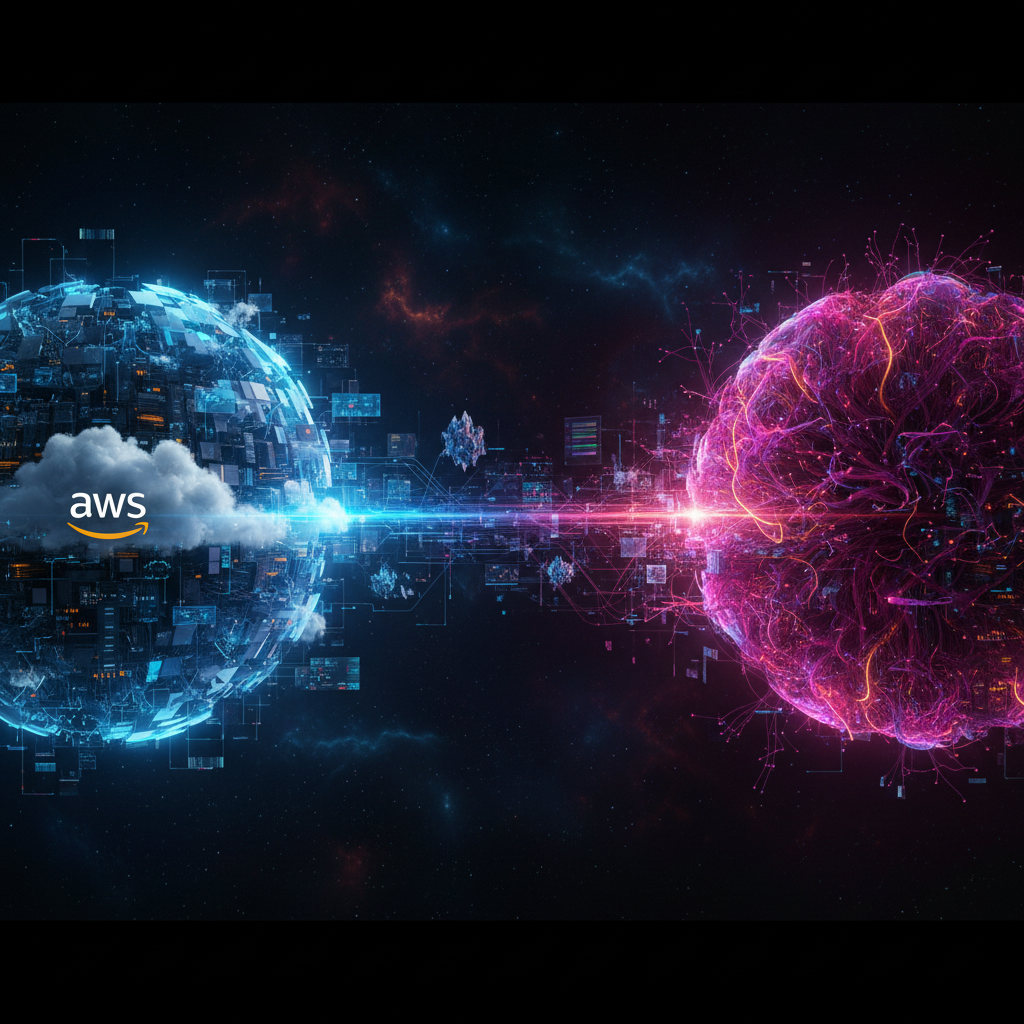
In a move that sends shockwaves through the tech industry, Amazon has finalized its monumental $4 billion investment in AI safety and research company Anthropic. The deal, capped by a final $2.75 billion infusion, represents Amazon's largest venture investment to date and solidifies a powerful alliance in the increasingly competitive artificial intelligence landscape. This is more than just a financial transaction; it's a strategic declaration of war in the battle for cloud supremacy, and this Amazon Anthropic investment analysis reveals a fundamental reshaping of the entire ecosystem.
The partnership makes Anthropic's cutting-edge foundation models, including the powerful Claude 3 family, deeply integrated with Amazon Web Services (AWS). Anthropic will leverage AWS as its primary cloud provider for mission-critical workloads, gaining access to vast computational power, including AWS Trainium and Inferentia chips. In return, AWS secures a formidable flagship AI partner to rival Microsoft's deep integration with OpenAI, setting the stage for a new era of fierce competition.
For enterprises and developers, this partnership signals a significant shift. The choice of a cloud provider is now inextricably linked to the AI models they offer. As we explore the implications, it becomes clear that the generative AI race is not just about building the smartest model—it's about creating the most powerful, integrated, and accessible platform for innovation.
The Landmark Deal: Unpacking Amazon's $4 Billion Bet
The structure of Amazon's investment is a testament to its long-term commitment. It began with an initial $1.25 billion in September 2023 and culminated in the recent $2.75 billion, finalizing the planned $4 billion total. While Amazon holds a minority stake and does not have a board seat, the message is unambiguous: AWS is all-in on Anthropic.
Anthropic, founded by former OpenAI executives, has differentiated itself with a strong emphasis on AI safety and constitutional AI. Their Claude series of models has consistently ranked at the top of performance benchmarks, often rivaling or even surpassing OpenAI's GPT series in specific tasks. The latest Claude 3 family—comprising Haiku, Sonnet, and Opus—is celebrated for its high-level reasoning, low latency, and large context windows.
This deal provides Anthropic with the immense capital and computing resources required to train next-generation models. The cost of developing frontier AI is staggering, and access to AWS's cutting-edge infrastructure, particularly their custom silicon (Trainium for training, Inferentia for inference), gives Anthropic a critical competitive advantage in the race to build more capable and efficient systems.
A New Battleground: The AI Cloud Wars Heat Up
The Amazon-Anthropic alliance directly challenges the established Microsoft-OpenAI partnership, creating a new bipolar dynamic in the cloud AI market. Google, with its own powerful Gemini models and a robust cloud platform, forms the third major pillar in this global contest.
Team Amazon + Anthropic: A Symbiotic Relationship
Based on our hands-on evaluation of the new offerings, the AWS-Anthropic partnership is designed for deep symbiosis. For AWS, the benefits are clear:
- A Flagship AI Offering: The Claude 3 models, available through Amazon Bedrock, provide AWS customers with a premier, ready-made generative AI solution that directly competes with Azure's OpenAI services.
- Driving Cloud Consumption: Training and running large language models are incredibly resource-intensive. By making AWS the primary home for Anthropic, Amazon ensures a massive, long-term revenue stream for its cloud services.
- Enterprise Credibility: Anthropic's focus on safety and reliability resonates with large enterprises, a key customer base for AWS. This alignment helps Amazon position itself as the trusted provider for business-critical AI applications.
For Anthropic, the partnership is equally transformative:
- Massive Scale: Access to AWS's global infrastructure and custom AI chips is essential for developing and deploying future models.
- Enterprise GTM: Tapping into AWS's vast sales and marketing channels provides Anthropic with immediate access to millions of customers, accelerating its go-to-market strategy.
Team Microsoft + OpenAI: The Incumbent Powerhouse
Microsoft's multi-billion dollar investment in OpenAI set the precedent for this type of mega-deal. Their partnership has been wildly successful, with OpenAI's models becoming the face of generative AI and driving significant growth for Microsoft's Azure cloud platform. The deep integration of services like "Azure OpenAI Service" has made it the go-to for many businesses starting their AI journey.
However, the Amazon-Anthropic deal signals that their dominance will not go uncontested. Customers now have a powerful alternative, potentially slowing Microsoft's momentum and forcing more competitive pricing and innovation.
Team Google: The Full-Stack Innovator
Google is in a unique position. It develops its own frontier models (Gemini) and hardware (TPUs) while also offering other models, including Anthropic's Claude, on Google Cloud Platform (GCP). This "full-stack" approach gives them control over their entire AI pipeline and allows them to offer a diverse marketplace of models. Industry analysts suggest this strategy of "model neutrality" could be a powerful long-term advantage, appealing to customers who want choice and flexibility without being locked into a single AI provider.
Data Table: Comparing the Cloud AI Alliances
To better understand the competitive landscape, here is a breakdown of the three major players in the AI cloud wars:
| Feature | Team Amazon + Anthropic | Team Microsoft + OpenAI | Team Google (Full-Stack) |
|---|---|---|---|
| Primary AI Partner | Anthropic (Claude 3) | OpenAI (GPT-4, GPT-4o) | Primarily Google's own models (Gemini) |
| Total Investment | $4 Billion from Amazon | ~$13 Billion from Microsoft | Primarily internal R&D; also invested in Anthropic |
| Cloud Integration | Deep integration via Amazon Bedrock | Deep integration via Azure OpenAI Service | Google Vertex AI offers both first- and third-party models |
| Key Differentiator | Enterprise focus, AI safety, model choice on Bedrock | First-mover advantage, strong brand recognition | End-to-end control, powerful search integration, choice |
| Custom Silicon | AWS Trainium & Inferentia | No widely-adopted custom AI chip for public use | Google TPUs (Tensor Processing Units) |
Real-World Example: How a GCM Firm Leverages Claude 3 on AWS
Let's consider a mini case study. "Stratacore," a fictional global consulting and marketing firm, was an early adopter of generative AI. Initially, they built tools on Azure OpenAI Service but faced challenges with model reliability for complex, multi-step reasoning tasks required for market analysis reports.
Following the expanded partnership, Stratacore began testing Claude 3 Opus on Amazon Bedrock. They discovered its larger context window and superior reasoning capabilities were ideal for synthesizing vast amounts of data from earnings calls, market research papers, and social media trends. They built a new internal platform on AWS that allows consultants to upload dozens of documents and ask complex questions. The system, powered by Claude 3, generates nuanced summaries, identifies emerging risks, and even drafts initial client-facing presentation slides.
By using AWS, Stratacore could keep their data within their existing cloud environment, simplifying security and governance. The speed of Claude 3 Sonnet was also used to power a real-time chatbot for their marketing teams, enabling them to quickly generate social media copy and email campaign ideas. This practical shift illustrates how the availability of a top-tier model on a preferred cloud platform can drive immediate business value.
What This Means for Your Business: Actionable Steps to Navigate the AI Cloud Market
For technology leaders, the landscape has become more complex but also rich with opportunity. Here are five actionable steps to take now:
- Re-evaluate Your Cloud Strategy: Your choice of cloud provider is now an AI strategy decision. Analyze whether your current provider (AWS, Azure, or GCP) gives you access to the models best suited for your specific business problems.
- Benchmark Foundation Models for Your Use Case: Do not assume one model is best for everything. Run pilot projects to compare models like GPT-4o, Claude 3 Opus, and Gemini 1.5 Pro on your own data and for your key tasks. Test for accuracy, speed, cost, and safety.
- Prioritize Model Independence and Multi-Cloud: Avoid vendor lock-in. Build your applications using APIs and abstraction layers (like Amazon Bedrock or Google Vertex AI) that make it easier to switch foundation models without re-architecting your entire system. Explore multi-cloud strategies where feasible.
- Invest in Skills and Experimentation: The most important investment is in your team. Create a culture of experimentation and provide training on prompt engineering, AI ethics, and how to use these new platforms. A small, empowered team can often find high-value use cases quickly.
- Focus on Data Security and Governance: As you connect powerful AI models to your corporate data, governance becomes paramount. Ensure you have clear policies on data residency, privacy, and security. Leverage tools within your cloud provider to maintain control over your data.
Common Pitfalls to Avoid
As organizations rush to adopt generative AI, several common mistakes can undermine success:
- Single-Provider Lock-In: Committing all your resources and architecture to a single model provider (e.g., only OpenAI on Azure) can be risky. If that model's performance wanes or its pricing changes, you have little leverage.
- Ignoring a "Portfolio of Models" Approach: Don't use a sledgehammer to crack a nut. The most powerful model (like GPT-4o or Claude 3 Opus) is also the most expensive. For simpler tasks like text extraction or classification, a smaller, faster, cheaper model like Claude 3 Haiku or GPT-3.5 Turbo can be far more efficient.
- Underestimating Data Strategy: The quality of your AI's output is directly tied to the quality of your input and data. A poorly managed or siloed data ecosystem will severely limit the effectiveness of any AI model.
- Chasing Hype Over Value: Avoid launching AI projects simply for the sake of "doing AI." Focus on solving real, measurable business problems. Start with a clear ROI in mind and scale from there.
The Future of Enterprise AI: A Multi-Polar World
Our Amazon Anthropic investment analysis concludes that this deal effectively ends any notion of a single winner in the AI race. Instead, we are entering a multi-polar era defined by powerful alliances. The fierce competition between Amazon/Anthropic, Microsoft/OpenAI, and Google will accelerate innovation, drive down costs, and ultimately benefit customers.
Enterprises will be the primary beneficiaries, gaining access to an unprecedented choice of powerful, well-integrated, and increasingly commoditized AI models from the cloud providers they already trust. The defining challenge will no longer be accessing AI, but strategically deploying it to create a sustainable competitive advantage.
About the Author
The neural.ai editorial team is a group of dedicated tech journalists, SEO strategists, and AI enthusiasts. With a combined decades of experience in the technology sector, our team is committed to delivering insightful, accurate, and practical analysis of the trends shaping the future of artificial intelligence. Our hands-on approach to testing and evaluation ensures our readers get a real-world perspective on the tools and platforms that matter.
Internal Linking Suggestions
- Anchor Text: Anthropic Claude 3.5 Sonnet Analysis
- Target Topic: Our recent deep dive into the performance and features of the new Claude 3.5 Sonnet model.
- Anchor Text: Best AI Tools to Build Autonomous AI Agents
- Target Topic: A guide to the frameworks and platforms available for creating AI agents for business automation.
- Anchor Text: What Is an NPU in an AI PC?
- Target Topic: An explainer on the hardware that will power the next generation of on-device AI.
- Anchor Text: How to Merge LLMs for Custom Models
- Target Topic: A technical guide on model merging techniques for creating specialized AI.
Related Articles to Explore
- The Rise of Sovereign AI: How Nations are Building Their Own LLMs
- AI Chip Wars 2026: NVIDIA vs. AMD vs. Intel vs. Custom Silicon
- Fine-Tuning vs. RAG: A Practical Guide for Enterprise AI
- The Economics of AI: Calculating the True Cost of Running Large Language Models
- Beyond the Hype: 5 Real-World Enterprise AI Success Stories
Key Takeaways
- ▸Amazon's final $2.75B investment solidifies a $4B alliance with Anthropic, directly challenging the Microsoft-OpenAI partnership.
- ▸The deal makes AWS the primary cloud for Anthropic, integrating the powerful Claude 3 models into the Amazon Bedrock service.
- ▸This move intensifies the "AI cloud wars" between AWS, Microsoft Azure, and Google Cloud, shifting the focus to integrated AI platforms.
- ▸Enterprises now benefit from greater choice but must strategically evaluate which cloud and AI model ecosystem best fits their needs.
- ▸The future of enterprise AI is a multi-polar landscape, where success depends on a flexible, multi-model strategy rather than loyalty to a single provider.
Frequently Asked Questions
What is the total investment Amazon made in Anthropic?+
Amazon has invested a total of $4 billion in Anthropic. This was completed in two stages: an initial $1.25 billion in September 2023, followed by an additional $2.75 billion in March 2024. This makes Anthropic a key strategic partner for Amazon Web Services (AWS) in the field of generative AI.
Why did Amazon invest in Anthropic?+
Amazon invested in Anthropic to secure a flagship generative AI partner for its AWS cloud platform. This allows AWS to offer a powerful alternative to the Microsoft Azure and OpenAI partnership. The deal provides AWS customers with access to Anthropic's state-of-the-art Claude 3 models and drives significant cloud consumption for training and inference workloads.
How does this investment affect the AI cloud competition?+
This investment significantly heats up the 'AI cloud wars.' It establishes a major alliance between AWS and Anthropic to compete directly with Microsoft's partnership with OpenAI. With Google also developing its own powerful models like Gemini, the market is now a three-way race, giving enterprise customers more choice and fostering greater innovation.
What is Claude 3 and why is it important?+
Claude 3 is a family of large language models (Haiku, Sonnet, and Opus) developed by Anthropic. They are highly regarded for their strong performance in reasoning, analysis, and safety. Their integration into Amazon Bedrock provides AWS with a top-tier AI offering that is competitive with OpenAI's GPT models, making it a critical asset in the AI platform competition.
Sources & further reading
Recommended AI Tools
Hand-picked tools related to this article — explore reviews, pricing, and use cases.
Stay ahead of the curve.
Bookmark neural.ai or share this article — new stories drop every 12 hours.
Explore more articlesRelated in AI News
- What is the Apple Intelligence Private Cloud Compute (PCC) Model?Explore Apple's new Private Cloud Compute (PCC) model, a groundbreaking system designed to process complex AI requests securely and privately in the cloud.
- What is OpenAI's GPT-4o Mini and How Does It Compare?OpenAI just released GPT-4o Mini, a smaller, faster, and cheaper version of its flagship multimodal model. Discover how it performs, its best use cases, and how it stacks up against GPT-4o.
- What is Google Project Astra and How Does It Work?Google Project Astra is a new conversational AI assistant that can understand and respond to multimodal inputs in real-time. But how does it actually work? We go in-depth.